

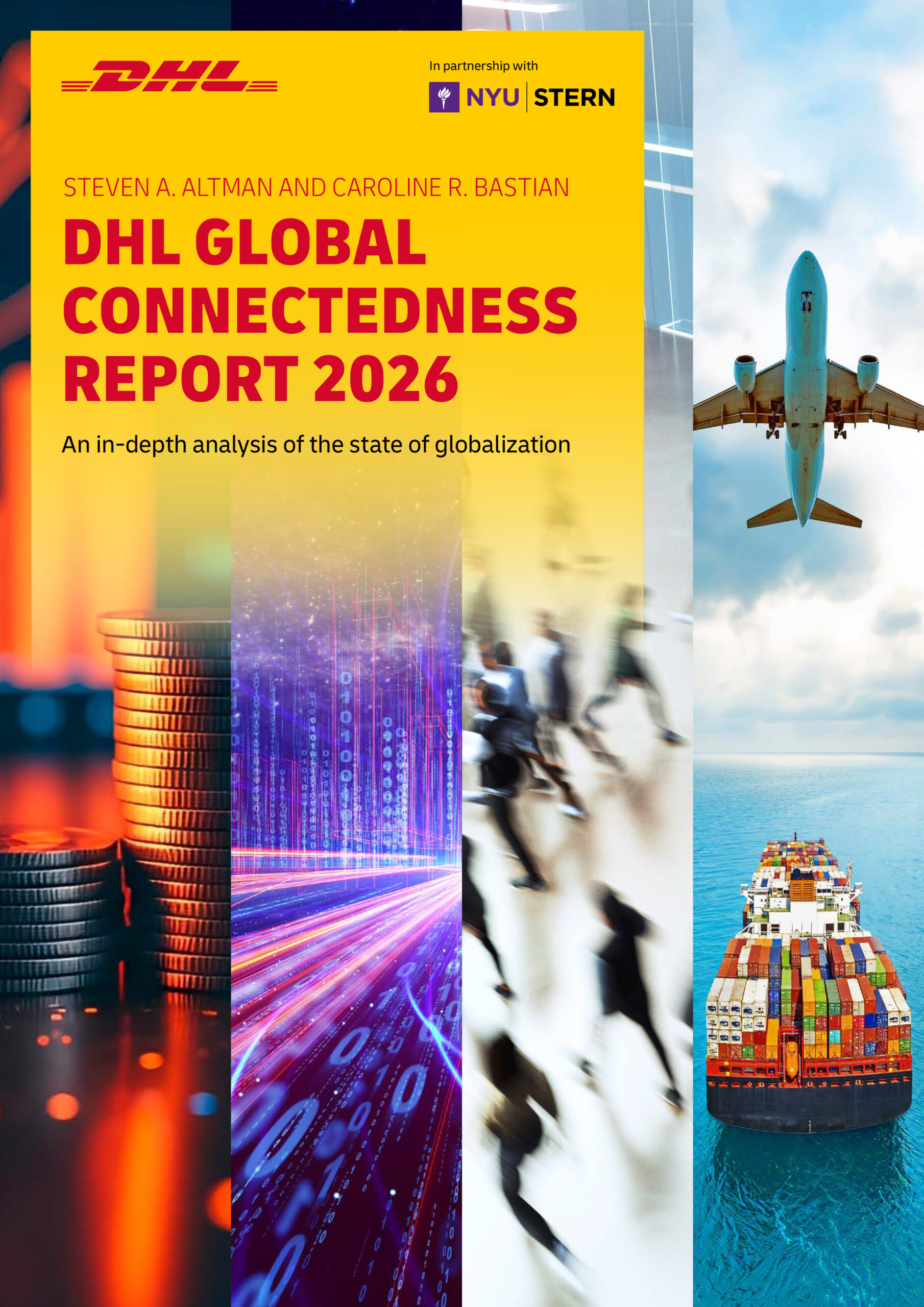
The DHL Global Connectedness Report 2026, commissioned by DHL and authored by Steven A. Altman and Caroline R. Bastian of New York University Stern School of Business, notes that globalization remains historically high amid escalating geopolitical tensions, rising U.S. tariffs, and unprecedented uncertainty about future trade policies.
The report tracking international flows of trade, capital, information, and people, which ranks the connectedness of more than 180 countries, notes that Sub-Saharan African economies saw a strengthening of their integration into global flows, while underscoring steady progress over time.
Namibia ranks among the countries with the largest increases in connectedness since 2001, with Mozambique also featuring among the strongest long‑run improvers. In recent times, Nigeria and Zambia are listed among the countries with the largest connectedness gains since 2022, reflecting growing momentum in trade, investment, and people flows.
CEO of DHL Express Sub‑Saharan Africa, Hennie Heymans, commented: “As supply chains across the globe continue to develop and trade routes expand into new territories, connectedness is emerging as a key differentiator for businesses and nations alike. The countries in our region that are strengthening their global links are becoming more visible in international trade networks. While this is an encouraging trend in terms of the scope of opportunities available, the key is to take advantage of these opportunities to drive consistent and reliable trade flows.”
“This report further underscores how Africa is increasingly shifting from a narrative of aid to one of trade, a transformation powered by stronger integration, rising competitiveness, and improved access to global markets. To fully unlock this potential, the region needs strong regional connectivity, predictable cross-border processes, and partners that understand both local conditions and global trade requirements. At DHL Express, we are committed to being a catalyst for growth in Africa, ensuring that not only is Africa a part of global trade but a key driver within it,” he added.
Beyond trade and investment, the report finds that people flow recovered fully, arising from the Covid‑19 collapse. While UN data shows that under tourism, Africa recorded a 17 percent increase in international arrivals in 2025 compared with 2019, considered as the second‑largest increase among world regions, behind the Middle East.
According to the 2024 country ranking of 180 economies, South Africa is ranked 53rd overall, while Sub‑Saharan African countries with relatively higher overall ranks include Seychelles (40th), Mauritius (65th), Namibia (68th), Ghana (97th), and Kenya (119th).
The report tracks globalization on a scale from 0 percent (no cross-border flows) to 100 percent (borders and distance have no impact). The world’s level of globalization was 25 percent in 2025, aligning itself with the record high set in 2022.
Over the past decade, only 4–6 percent of global goods trade, greenfield FDI, and cross-border M&A have shifted away from geopolitical rivals. Of these flows, most have not moved to close allies but to countries with flexible geopolitical positions, such as India and Vietnam. Overall, the world economy remains far from a broad split into rival blocs.
“The politics and policy surrounding globalization are much more volatile than the actual flows between countries,” said the Director of the DHL Initiative on Globalization at NYU Stern’s Center for the Future of Management, Prof. Steven A. Altman. “Global trade patterns changed more in 2025 than they do in a typical year, but less than they did during other recent disruptions such as the early stages of the war in Ukraine. Sound decision-making requires a calibrated view of how much global business ties are really changing. The risks to globalization are real, but so is the resilience of global flows.”