


- MCCI holds 177th Annual General Meeting in March to discuss Mauritius’ economic outlook and strategic priorities
- Speakers emphasise importance of stronger public-private collaboration, industrial transformation and strategic engagement with international partners
- Upcoming US-Africa Business Summit consistently highlighted as a key milestone in positioning Mauritius as a leader in global trade
The Mauritius Chamber of Commerce and Industry (MCCI) held its 177th Annual General Meeting on 26 March 2026 at the Caudan Arts Centre in Port Louis, bringing together key public and private sector stakeholders to discuss the country’s economic outlook and strategic priorities. Mr. Patrice Marie and Mr. Denis Claude Pilot were elected as President and Vice-President of the MCCI respectively.
The event was attended by the Honourable Minister of Foreign Affairs, Regional Integration and International Trade, Mr Dhananjay Ramful; the Honourable Minister of Industry, SMEs and Cooperatives, Mr Aadil Ameer Meea; the Honourable Minister of Commerce and Consumer Protection, Mr Michaël Yeung Sik Yuen; as well as MCCI members and representatives of the business community.
Discussions centred on navigating a complex global environment marked by geopolitical tensions, trade uncertainty, and rising costs, while positioning Mauritius for sustainable and resilient growth. Across interventions, speakers emphasised the importance of stronger public-private collaboration, industrial transformation, and strategic engagement with international partners.
Mauritius must be ever resilient in the face of global economic uncertainty

Photo Credit: GIS
In his address, outgoing MCCI President Charles Harel pointed to a rapidly evolving global landscape where uncertainty has become the defining feature. He highlighted that weakening export performance, subdued investment, and structural vulnerabilities require a coordinated and forward-looking response. Stressing the importance of adaptability, he noted that “success now hinges on our ability to respond quickly and embrace change,” while reaffirming confidence in Mauritius’ fundamentals as a stable and resilient business platform.
Mr Harel outlined a set of key priorities for the economy, including the need to stimulate private investment, enhance ease of doing business, and focus on high-potential sectors. He called for a balanced approach combining fiscal discipline with growth-oriented policies, noting that businesses require “a clear roadmap… to plan, adjust, and invest with confidence.” He further underscored the importance of strengthening public-private partnerships, modernising the financial services sector, addressing labour and immigration challenges, and boosting service exports as a key driver of future growth.
He also emphasised the growing importance of economic diplomacy, urging Mauritius to secure market access, attract strategic investment, and integrate more effectively into global and regional value chains. In this context, he reiterated the Chamber’s commitment to supporting national efforts to enhance competitiveness and resilience.
Forthcoming Industry Bill to be introduced in National Assembly

Photo Credit: GIS
For his part, Minister Aadil Ameer Meea highlighted the impact of global instability on Mauritius’ trade-dependent economy, noting that rising uncertainty increases the cost of doing business and disproportionately affects small economies. He reassured the business community that government is actively monitoring global developments and implementing measures to mitigate their effects, emphasising resilience, discipline, and partnership as key to navigating current challenges.
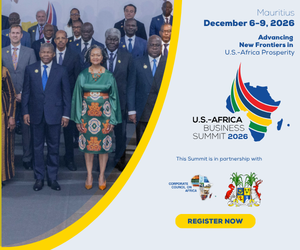
The Minister also pointed to the upcoming US-Africa Business Summit, to be hosted in Mauritius in July 2026, as a major opportunity to deepen trade and investment ties with the United States and the wider African region. He described the event as a strategic platform to position Mauritius as a credible gateway for international partnerships and investment flows.
The Honourable Minister further announced that the forthcoming Industry Bill will soon be introduced in the National Assembly, marking a significant step in strengthening the country’s industrial framework. He explained that the Bill will serve as an umbrella legislation to guide industrial development, support manufacturing transformation, improve coordination, and enhance export capacity. “This is not merely a legislative exercise; it is a statement of national ambition,” he said, adding that it will lay the foundation for a modern, competitive, and innovation-driven industrial economy.
Vigilance and proactive management key to respond to ongoing geopolitical tensions

Photo Credit: GIS
Minister Michaël Yeung Sik Yuen, meanwhile, drew attention to the broader global context, particularly ongoing geopolitical tensions in the Middle East, and their ripple effects on global supply chains and domestic economic stability. He noted that rising petroleum prices and market volatility are already placing pressure on businesses and consumers, warning that “tough times are on the way” as external shocks continue to impact the local economy.
He stressed the importance of vigilance and proactive management in responding to these challenges, while maintaining a balance between consumer protection and business sustainability in an increasingly uncertain environment.
Mauritius to be positioned as resilient, innovation-driven economic hub

Photo Credit: GIS
Minister Dhananjay Ramful reaffirmed Government’s commitment to strengthening Mauritius’ position as a resilient and innovation-driven economic hub. He highlighted the importance of economic diplomacy in opening new markets and leveraging existing trade agreements, noting that Mauritius already benefits from preferential access to markets covering a significant share of the global population.
He also addressed existing trade imbalances with key partners such as the European Union, the United Kingdom, and India, underlining the need for Mauritian businesses to better leverage these agreements to expand exports and integrate into regional value chains. At the same time, he emphasised the critical role of the MCCI as a bridge between the public and private sectors, ensuring that policy remains aligned with the realities of the marketplace.
Mauritius as a strategic link between Africa and global markets, US-Africa Summit beckons
The Honourable Minister further positioned Mauritius as a strategic link between Africa and global markets, highlighting opportunities in sectors such as digital services, financial services, and the blue economy.
He concluded by calling for a collective effort to transform challenges into opportunities, stating that “together, we can make Mauritius not just a participant in global trade, but a leader.”
Hearteningly, the upcoming US-Africa Business Summit was consistently highlighted as a key milestone in positioning Mauritius as a leader in global trade.
With thousands of high-level participants expected, the Summit is set to reinforce Mauritius’ role as a gateway to Africa, facilitating investment, strengthening partnerships, and advancing the country’s ambition to become a hub of resilience, innovation, and sustainable growth.

Photo Credit: GIS