

As part of the National Research Week 2026, organised by the Mauritius Research and Innovation Council (MRIC) from April 20 to 24, Middlesex University Mauritius held its Research Symposium 2026 on Thursday, April 23.
Held under the theme “Innovating Together for Sustainable Futures” at the University’s Flic-en-Flac campus, the event brought together academics, doctoral candidates, students, and external researchers.
The programme featured 36 presentations, highlighting the diversity of research projects undertaken within the institution and their relevance in addressing today’s challenges, from an economic, technological, environmental, or societal standpoint.
This symposium, showcasing value-added projects, forms part of a broader national momentum aimed at strengthening research and innovation in Mauritius, by reinforcing connections between the academic world, professional sectors and the country’s development priorities.
Middlesex University Mauritius, present throughout all thematic sessions of the National Research Week and actively involved in technical committees, has reaffirmed its commitment to building a structured and collaborative research ecosystem, with a clear focus on delivering impact at an international level.
Topics covered included digital technologies and intelligent systems, organisational transformation for sustainable value creation, and key issues related to law, ethics and governance. Similarly, the discussions also explored financial systems, sustainable economic development, as well as education and psychology.
Several research projects presented practical applications of artificial intelligence (AI) and machine learning in healthcare, notably in the early diagnosis of neurodegenerative diseases, as well as initiatives aimed at strengthening cybersecurity within educational environments.
Sustainability-related issues were also examined through research on energy planning and the adoption of new organisational practices that reconcile performance with responsibility. An important feature of this edition was the strong involvement of students.
A dedicated student track was integrated into each of the five thematic streams, resulting in 17 presentations delivered either independently by students or jointly with members of the academic staff. These contributions brought together both undergraduate and postgraduate students, reflecting the University’s commitment to fostering early engagement in research.
In the field of governance and legal studies, presentations examined how legal frameworks must adapt to the rise of generative AI, raising critical questions of accountability and compliance. Economic analysis focused on financial resilience and the transformation of development models during periods of transition.
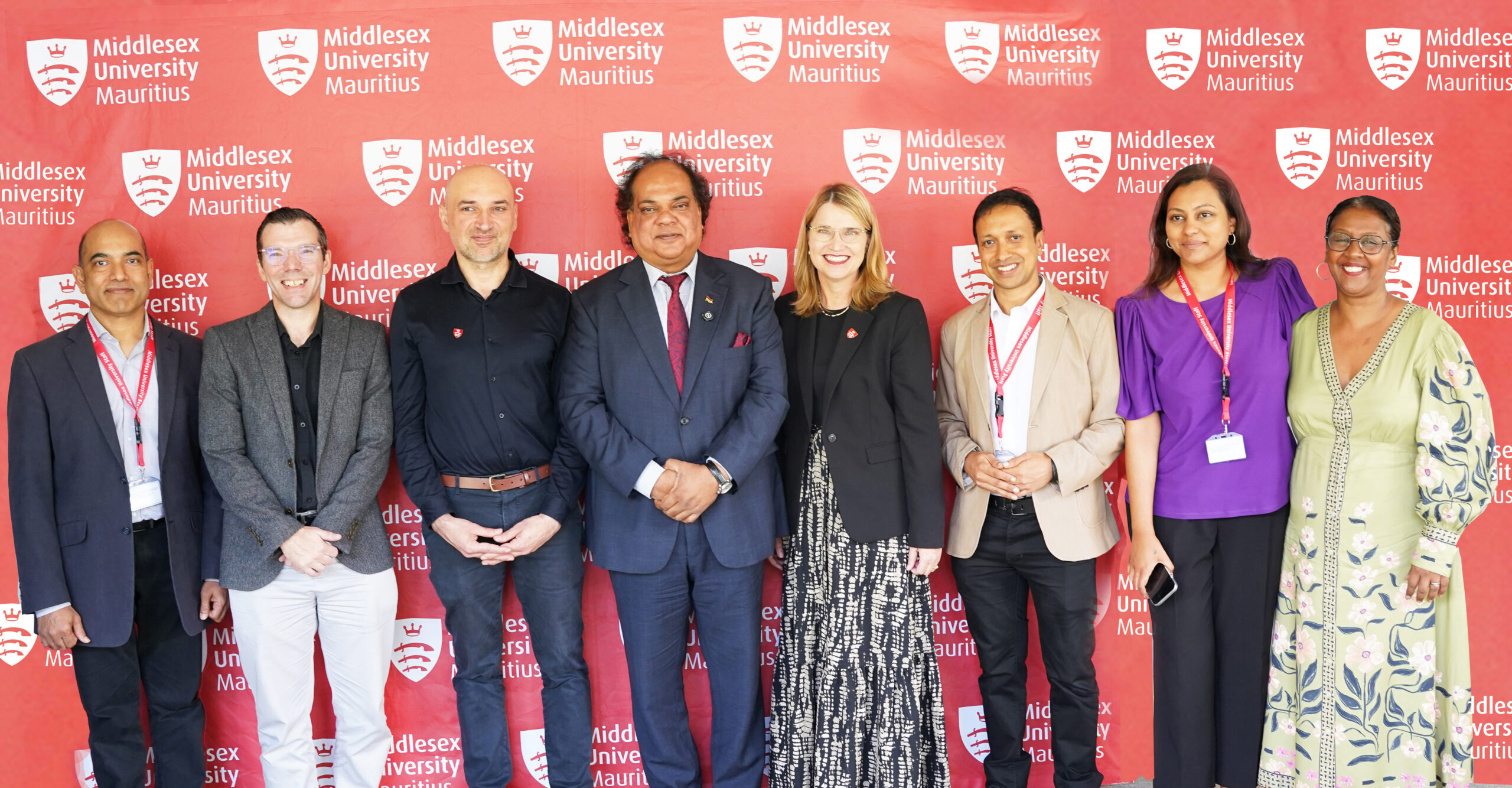
In her opening address, Pro Vice-Chancellor and Director of Middlesex University Mauritius Professor Mari Jansen Van Rensburg, underlined the strategic importance of the symposium in an increasingly complex global environment.
“In a world marked by geopolitical, economic and social tensions, universities have a vital role to play as spaces for rigorous thinking, ethical dialogue and solution-oriented collaboration. This symposium provides a platform to mobilise knowledge and contribute meaningfully towards sustainable futures,” she stated.
The event also saw the presence of Minister of Higher Education, Science and Research Honourable Dr Kaviraj Sharma Sukon, who emphasised that, for an island nation such as Mauritius, research must be approached as a collective endeavour rather than developed in silos.
While encouraging private institutions to become more actively involved in national research efforts, the Minister highlighted the importance of interdisciplinarity in responding to challenges such as public health and the energy transition.
He also cautioned against the automatic use of inappropriate statistical models, advocating for methodological rigour to ensure reliable and actionable results.
The symposium also welcomed the Director of Doctoral Studies at Middlesex University, London, Dr. Nico Pizzolato. His presence reinforced the strong synergy between the University’s campuses and Middlesex’s identity as an institution committed to applied research.
“In a demanding global environment for higher education, Middlesex University, across its three campuses, continues to develop students’ capabilities and strengthen its links with civic and economic organisations in order to generate real impact on society,” Dr Nico Pizzolato noted.
The 2026 edition encouraged meaningful exchanges between researchers and socio-economic partners, further consolidating the University’s interdisciplinary approach. It confirmed Middlesex University Mauritius’ commitment to fostering high-level academic publication and developing long-term strategic collaborations.
“This symposium reflects the scope, quality, and ambition of the research conducted by our teams and students. It provides a space to broaden our perspectives, strengthen academic networks, and encourage publication in reputable journals,” concluded Professor Mari Jansen Van Rensburg.