


By Shruti Menon Seeboo
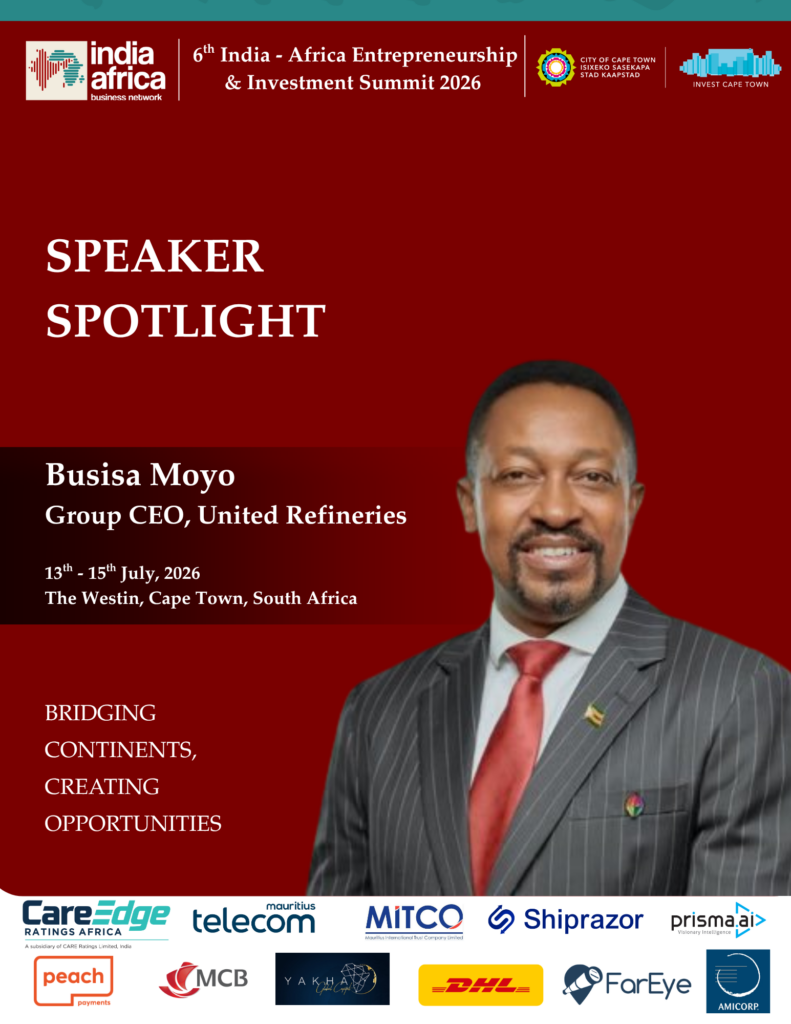
When the 6th India-Africa Entrepreneurship & Investment Summit convenes in Cape Town from 13 to 15 July, few voices will carry the grounded authority of Busisa Moyo. Group Chief Executive Officer of United Refineries — one of Zimbabwe’s largest integrated edible oil, soap, and stockfeed manufacturing companies, Moyo is a business leader, industrialist, and entrepreneur with more than two decades of experience navigating some of the continent’s most demanding economic conditions. A Chartered Accountant who completed his articles with the Institute of Chartered Accountants of Zimbabwe, he holds a Bachelor of Accounting Science from the University of South Africa and a Global Executive MBA from IESE Business School in Spain, with executive education in mergers and acquisitions at the University of Chicago. He also serves as Chairman of the Zimbabwe International Trade Fair and sits on the board of First Capital Bank. At this year’s Summit, he arrives with a message that is equal parts pragmatic and urgent: Africa must stop exporting its raw potential and start building the value chains that create lasting prosperity from within.
The lessons Moyo has drawn from running a manufacturing business in Zimbabwe go well beyond operational resilience. For him, they point to a structural imperative for the entire continent. “It is time for Africa to domesticate not just production but the raw material inputs that produce products that are sold and distributed on the continent,” he says. “This way we will spawn and proliferate job creation all along the upstream and downstream from the manufacturing units.” He sees India — with its relevant technology and deep experience in industrial scaling — as a natural partner in this effort. “The rest of the world, and especially India, can assist in upgrading and upskilling our people through technological alliances and procurement,” he says, adding that Africa’s youth dividend — with an average continental age of just 19 years — makes the urgency of intentional policy and programme design to expand employment capacity along value chains all the more pressing.
On the question of agro-processing, Moyo is equally direct. Africa continues to export far too many raw commodities, and reversing that trend requires deliberate policy choices. “Government should craft progressive policies, programmes and engender practices that encourage value addition for local markets as well as export markets,” he says. India’s track record as a recently emerging economy — with vast experience in mechanising, automating, and embedding technologies that improve quality and enhance the scale of output — positions it well for both business-to-business and government-to-government partnerships with African counterparts, he argues, in areas of mutual economic interest.
As Chairman of ZIDA, Moyo has a front-row view of where international investors misread Zimbabwe — and what they consequently miss. He is particularly pointed about a fundamental misunderstanding around currency risk. “Most investors don’t know that Zimbabwe is operating a multi-currency system where the United States Dollar is the most dominant currency in the basket and constitutes 60 percent-plus of all transactions,” he says, “and the ZiG local currency is backed by gold and foreign currency reserves.” For any entity generating US dollar revenues, the ability to pay shareholders and loan holders directly from its bank account — without navigating currency conversion — significantly de-risks a Zimbabwe-based operation from the exchange rate pressures that characterise most developing economies. It is, he suggests, an opportunity that too many Indian investors are overlooking.
On the question of human capital, Moyo resists reducing the concept to training programmes alone. “In Africa, investing in human capital means education, training and re-training, but also unlearning old colonial models of business and organisational design,” he says, “as well as exposure to current cutting-edge management methods and tools such as Artificial Intelligence.” It is a vision of human development that is as much about mindset as it is about skills — and one that speaks directly to the IA HCC’s broader mission of building the human foundations for sustainable continental growth.
As Cape Town prepares to host this landmark gathering, Moyo brings to the table something rarer than data or projections: the hard-won perspective of someone who has built, sustained, and grown a manufacturing enterprise in one of Africa’s most complex environments — and who believes, unequivocally, that the continent’s best days lie ahead.