

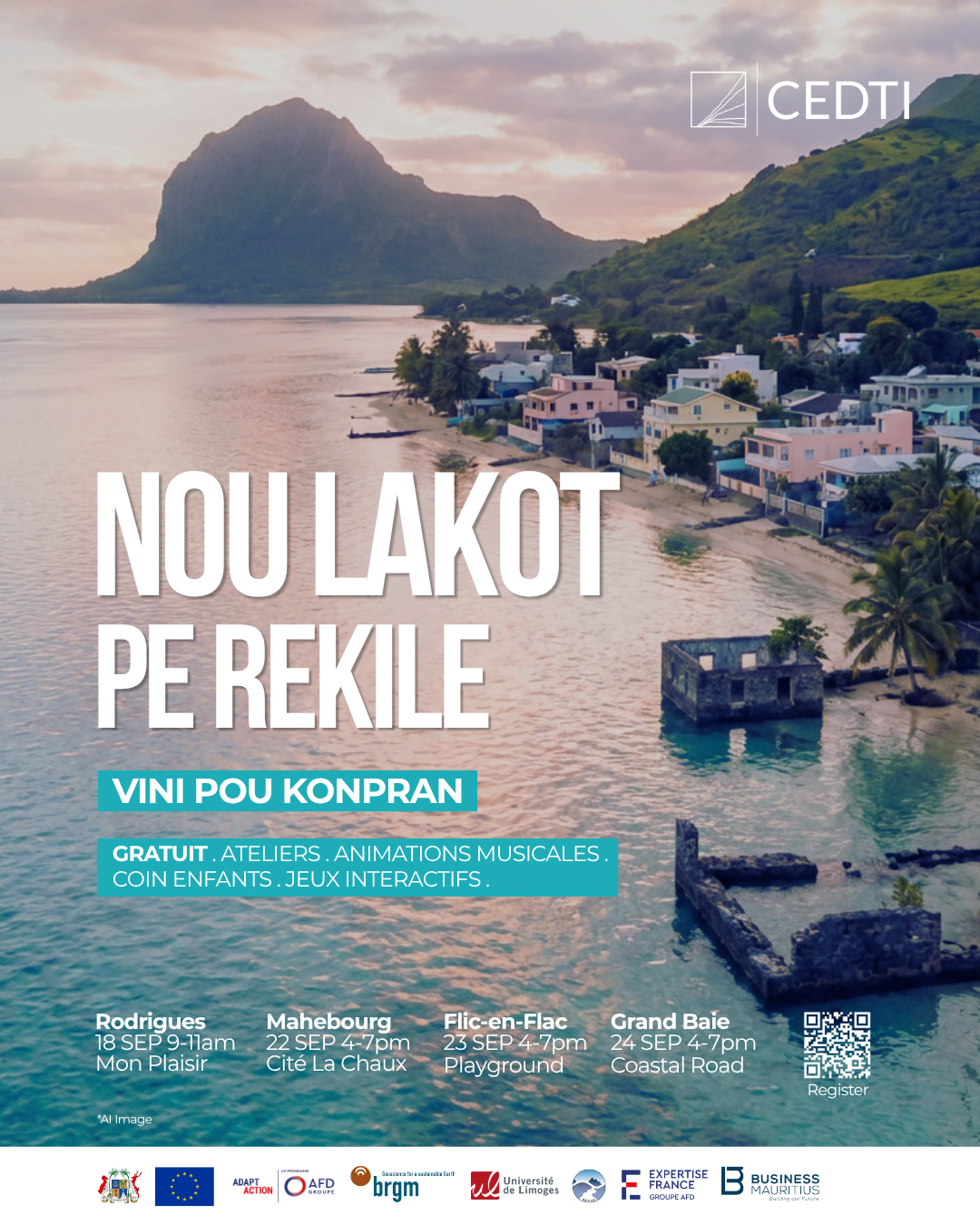
Mauritius is taking a closer look at the future of its coastline as rising climate risks, coastal erosion and marine flooding increasingly raise questions about how the island should plan, build and adapt in the decades ahead. A new series of five workshops, to be held across Mauritius and Rodrigues from 18 to 25 September, will bring scientific experts, public institutions, communities, businesses and civil society together to examine what is happening along the island’s shores and, more importantly, what can be done about it.
The initiative, titled “Nou Lakot Pe Rekile: Ki Pou Reste?”, marks the latest phase of a national conversation on coastal risks that began in 2025. At its centre is the MAURISCOT study, a major assessment of coastal dynamics commissioned by the Mauritian Government and conducted by the Bureau de recherches géologiques et minières (BRGM), in partnership with the GEOLAB laboratory of the University of Limoges and Météo-France La Réunion. The study, carried out between 2022 and 2025, examines coastal erosion, shoreline retreat and marine flooding in Mauritius and Rodrigues, while looking at how these risks could evolve under climate change by 2050 and 2100. Its findings provide a scientific basis for a conversation that is becoming increasingly difficult to ignore. By 2050, an average stretch of 20 to 30 metres of coastline could be affected by erosion and shoreline retreat, although the scale of the impact will vary considerably from one location to another. At the same time, areas already exposed to very high marine flooding risks during major cyclones could face greater levels of exposure in the future.
From research to real-world decisions
The challenge now is to turn scientific findings into knowledge that communities and decision-makers can understand and use. That is the purpose of the September workshops. Rather than keeping the discussion within scientific or institutional circles, the initiative will take the findings of MAURISCOT directly to several coastal communities, creating space for residents and local stakeholders to compare scientific assessments with what they see and experience on the ground.
The workshops are being led by Business Mauritius and financed by the French Development Agency (AFD) through funds delegated by the European Union, with implementation by Expertise France. The Centre d’Études pour le Développement Territorial Indo-océanique (CEDTI) has been tasked with designing and facilitating the workshops, bringing expertise in territorial planning, climate adaptation and local stakeholder engagement. Two experts from BRGM and GEOLAB will also travel to Mauritius and Rodrigues to present the study’s findings and place them in context.
A conversation that began last year
The September programme builds on two national conferences held in 2025. The first, in May last year, focused on the state of knowledge surrounding coastal erosion and marine flooding, as well as the institutional and legal framework governing coastal risk management. A second conference in July moved the discussion towards possible solutions, examining five areas: knowledge, management approaches, strategic planning, governance and financing.
Together, the meetings highlighted the need for a common and accessible understanding of coastal risks, stronger cooperation between stakeholders and a long-term vision for Mauritius’ coastline.The latest workshops are intended to take that process one step further from national discussion to local engagement. Residents and stakeholders will have the opportunity not only to learn about the findings of MAURISCOT, but also to contribute their own observations and experiences.
Making a complex issue easier to understand
Organisers are also using new tools to make the scientific findings more accessible. An educational booklet has been developed in English, French and Creole, translating key findings from MAURISCOT into language that can be understood by a wider audience. An immersive serious game will also put participants in the shoes of people managing a fictional coastal town in Mauritius facing both current and future coastal risks. The idea is to move the discussion beyond technical projections and allow participants to explore the consequences of different decisions in a changing coastal environment.
Five workshops, one national conversation
The series of workshops will begin with public sessions across Mauritius and Rodrigues:
- 18 September 2026 – Rodrigues: Mon Plaisir Cultural Centre, 9:00 a.m. to 11:00 a.m.
- 22 September 2026 – Mahébourg: Cité La Chaux Social Welfare Centre, 4:00 p.m. to 7:00 p.m.
- 23 September 2026 – Flic-en-Flac: Flic-en-Flac Community Centre, 4:00 p.m. to 7:00 p.m.
- 24 September 2026 – Grand Baie: Grand Baie Social Welfare Centre, 4:00 p.m. to 7:00 p.m.
- 25 September 2026 – Bagatelle: Voilà Bagatelle Hotel, national multi-stakeholder workshop by invitation, 10:00 a.m. to 12:00 p.m.