


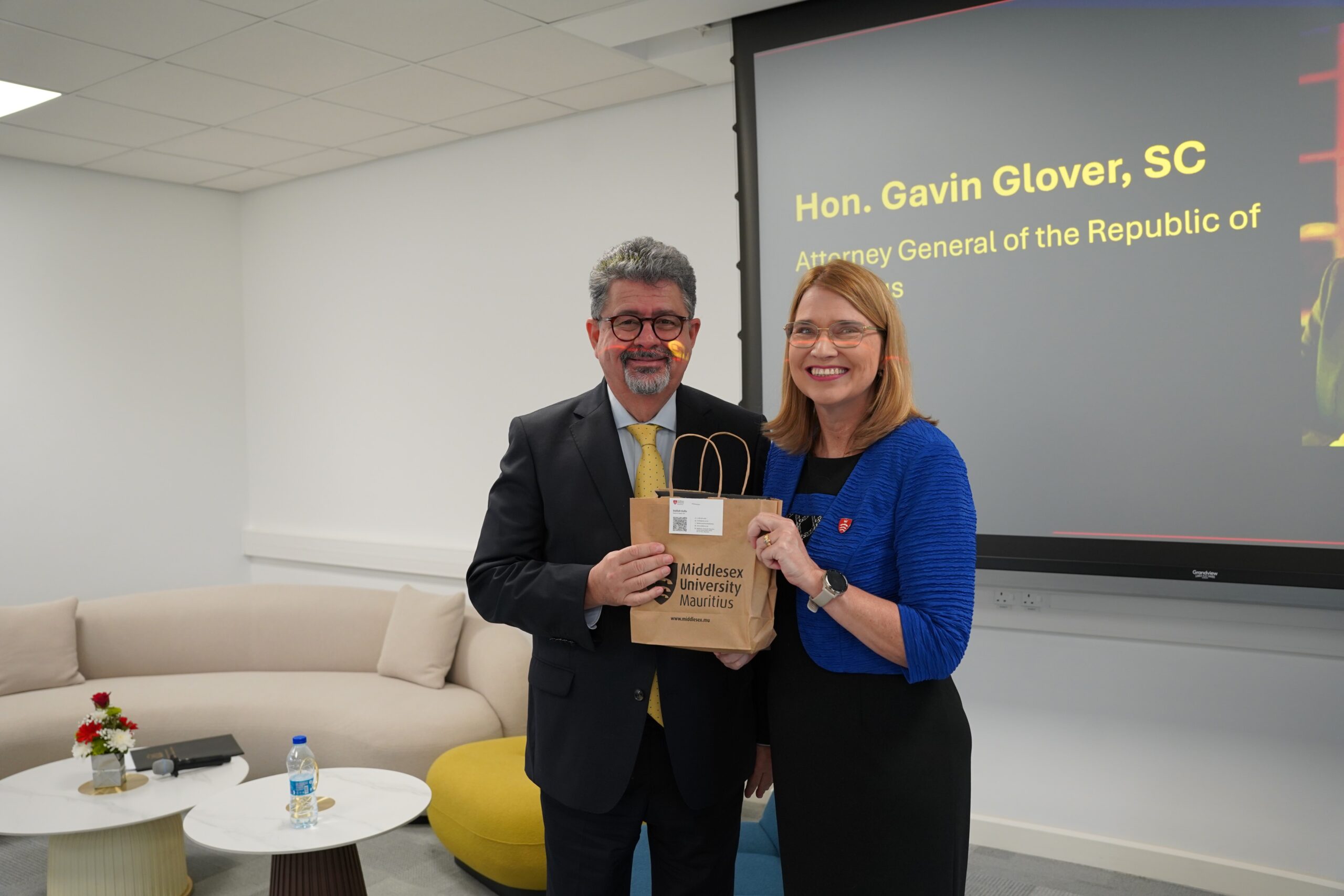
Mauritius’ ambitions to strengthen its position as a regional centre for international arbitration took centre stage this week as leading legal practitioners, academics, arbitrators and aspiring lawyers gathered at Middlesex University Mauritius for an International Arbitration Colloquium. Held on 8 September at the university’s Flic-en-Flac campus, the event brought together established voices from the legal profession alongside young barristers and law students from across the island, creating a forum for discussion on some of the forces reshaping international dispute resolution.
The colloquium was initiated by Vandana Sunnasy, Lecturer in Law at Middlesex University Mauritius and Founder and Chair of the Mauritian Arbitration Academy. It was held under the auspices of the Mauritius International Arbitration Centre (MIAC) and organised in strategic collaboration with Middlesex University Dubai. The timing was significant. With technology transforming legal practice and businesses operating across increasingly complex international markets, arbitration itself is undergoing rapid change.
Important announcements for Mauritius’ arbitration landscape
Among the most significant moments of the colloquium came from Attorney General Gavin Glover, who used the university platform to announce a number of developments affecting Mauritius’ dispute-resolution framework. He confirmed that Mauritius has deposited its instrument of ratification of the Singapore Convention on Mediation, which is expected to enter into force for Mauritius in February 2027. The Attorney General also announced plans for a dedicated legislative framework and the forthcoming merger of MIAC and the Mauritius Arbitration and Mediation Centre (MARC) into a unified institution. The announcements underline the pace at which Mauritius’ arbitration and mediation ecosystem is evolving, while also placing greater emphasis on the country’s ability to offer a modern and internationally competitive framework for resolving commercial disputes.
Speaking directly to the students attending the event, Glover stressed the responsibility of the next generation to build on the foundations laid by those before them. “My generation built the framework and the door. It is your generation that must open that door and walk through it.” The message resonated with the broader purpose of the colloquium which is bringing students and young legal professionals into direct contact with practitioners and experts shaping the future of the profession.
Connecting the classroom with the legal profession
For Middlesex University Mauritius, hosting the event was also an opportunity to demonstrate the role a university can play within the wider legal ecosystem. In her welcome address, Professor Mari Jansen Van Rensburg, Provost and Director of Middlesex University Mauritius, emphasised the importance of creating meaningful connections between academic learning and professional practice. “Arbitration provides a powerful bridge between academic learning and the realities of professional practice,” she said. She pointed to the university’s growing law community, noting that its Law programme had secured first place among 85 universities in the latest Daily Mail University Rankings, while more than 600 students are expected across its LLB and LLM programmes.
For the university, the ambition is not simply to prepare students to enter the legal profession, but to ensure they understand the changes that are likely to shape it.
Three issues shaping the future of arbitration
The day’s discussions focused on three major areas. The first examined the enforcement of arbitral awards in Mauritius and across Africa, a subject central to the credibility and effectiveness of arbitration as an alternative to traditional court proceedings. The second turned to artificial intelligence and its growing role in legal practice. Discussions explored how AI could influence areas ranging from evidence management to the drafting of arbitral awards, while raising broader questions about how lawyers should adapt to increasingly technology-driven practices. The final panel looked at the changing role of arbitral institutions in the Middle East and Africa, reflecting the growing importance of these regions in international commercial dispute resolution. Together, the discussions painted a picture of a profession being reshaped on several fronts, by technology, by evolving institutional structures and by the growing importance of emerging arbitration centres.
Investing in the next generation
One of the defining features of the colloquium was its emphasis on young legal professionals. LLM students, selected undergraduate law students and early-career barristers were given the opportunity to engage directly with experienced arbitrators, academics and practitioners. For students, the experience offered something that cannot easily be replicated in a classroom: a direct view of how legal principles are applied to complex, real-world disputes and how the profession itself is changing.
The initiative also builds on the work of the Mauritian Arbitration Academy, led by Sunnasy as Founder and Chair and Professor Andrew Skudder as Co-Chair, with contributions from international academics and practitioners including Yasmin Sebah, Senior Lecturer in Law at Middlesex University Dubai.
For Vandana, creating this kind of exchange is increasingly important as international arbitration enters a period of rapid transformation. “International arbitration is undergoing rapid change. We needed a space where academics and practitioners could share their first-hand experiences and anticipate the challenges ahead.” She added that the event demonstrated Mauritius’ ability to bring together the infrastructure, expertise and international networks required to host high-level conversations around international justice.
A strategic role for Mauritius
The colloquium ultimately pointed to a broader opportunity for Mauritius. Its geographical position between Africa and Asia, combined with its established financial and legal services sectors, has long given the island ambitions of serving as a gateway for international business.