


By Shruti Menon Seeboo
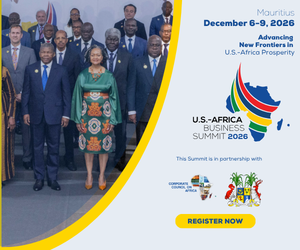
With just four weeks to go before Mauritius hosts the flagship U.S.-Africa Business Summit (December 6–9, 2026), the stage is set to showcase Africa’s primary investment corridors. As a Diamond Sponsor for this landmark gathering, Standard Bank Mauritius—backed by the group’s extensive 21-country continental footprint—is at the forefront of connecting international capital to scalable, high-impact opportunities across the region.
In an exclusive interview with Platform Africa, Francois Gamet, Chief Executive of Standard Bank Mauritius, shares insights on navigating trade complexities, accelerating U.S. capital deployment, and framing Mauritius as an essential financial command centre for Africa-bound investment. Excerpts:
1. Standard Bank’s footprint across Africa gives it a distinct perspective. How is the bank leveraging this scale to connect U.S. corporate clients with on-the-ground opportunities?
Africa is not one market. Each country has its own regulatory environment, economic dynamics and opportunities. Standard Bank’s strength lies in combining deep local knowledge with international connectivity to help U.S. corporates navigate that complexity.
Our role is to connect clients with market insight, sector expertise and banking solutions that support them as they establish, expand and transact across African markets. From trade finance and cash management to foreign exchange, risk management, advisory and funding solutions, our objective is to help businesses move from identifying an opportunity to executing it successfully.
Our African network gives international clients something particularly valuable: proximity to the markets in which they want to grow, supported by a banking partner that understands the continent.
2. How is Standard Bank helping multinational clients navigate the AfCFTA framework to optimise supply chains and cross-border trade?
AfCFTA can reshape the way companies think about Africa, moving the conversation from individual markets towards regional value chains and a more integrated continental marketplace. For multinational clients, that creates opportunities to reconsider sourcing, manufacturing, distribution and treasury structures. Standard Bank supports clients with the banking infrastructure that enables cross-border activity, including trade finance, payments, cash management, foreign exchange and risk solutions.
Importantly, we combine these capabilities with insights from businesses operating across Africa. The latest Standard Bank Africa Trade Barometer points to improvements across major infrastructure categories and notes that deeper AfCFTA implementation, alongside greater harmonisation of customs, regulation and logistics platforms, can support regional value chains and competitiveness. Our focus is therefore on helping clients translate continental integration into practical commercial opportunity.
3. Given current macroeconomic shifts, what emerging trends are you observing in U.S. capital deployment into African markets?
We are seeing a growing emphasis on sustainable opportunities with economic impact, particularly in infrastructure, energy and the digital economy. The financing requirement across Africa is significant, and this means there is an important role for different forms of capital. Depending on the project and market, opportunities can require a combination of project finance, corporate debt, equity, development finance and other risk-sharing structures.
What is particularly encouraging is the increasing focus on converting investment conversations into executable transactions. This is also highly relevant to this year’s Summit, whose programme spans financial services, ICT, renewable energy and other sectors, and is explicitly intended to catalyse commercial opportunities and deal-making. For Standard Bank, the opportunity is to connect international pools of capital to credible African projects, businesses and opportunities.

4. How does Standard Bank utilise its Mauritius operations to serve global corporate treasuries, fund managers, and cross-border investment structures?
Mauritius occupies an important position in the Standard Bank extensive footprint because it combines a recognised international financial centre with strong connectivity to the 21 African markets the Standard Bank Group is present.
For multinational corporations, Mauritius can provide a base from which to manage African operations and financial flows. Standard Bank Mauritius complements that positioning through capabilities across corporate and investment banking and business and commercial banking, supporting clients operating in, for and across Africa. The Mauritius platform is an opportunity for corporations to establish a financial command centre for African operations.
More broadly, our Mauritius proposition brings together the jurisdiction, Standard Bank’s African network and global banking capabilities. It enables us to support clients requiring solutions around liquidity, trade, foreign exchange, risk management and cross-border financing.
Standard Bank Mauritius acts as a bridge between global capital and African opportunity.
5. How is Standard Bank aligning its energy and infrastructure financing with climate transition goals across African economies?
Africa’s transition needs to respond to two realities: the imperative to address climate change and the need to expand energy access, infrastructure and economic opportunity on the continent.
Standard Bank’s approach recognises that this is a just energy transition and it will not look identical in every market. The priority is to support solutions that advance decarbonisation and resilience while recognising individual countries’ development needs.
This includes financing renewable energy and sustainable infrastructure and supporting clients as their businesses transition. Standard Bank’s sustainability reporting also frames its approach around a just energy transition, balancing emissions reduction with Africa’s development and energy-access requirements. Our ambition is therefore to help finance Africa’s long-term, resilient and inclusive growth.
6. What key outcomes does Standard Bank hope to achieve from this edition of the U.S.-Africa Business Summit?
The most important outcome would be to see conversations turn into connections, and connections into tangible trade and investment. This summit is an opportunity to bring U.S. businesses, African corporates, investors, governments and financial institutions together around real opportunities. The official summit positioning emphasises high-level engagement, new commercial opportunities and deal-making between U.S. and African participants.
For Standard Bank, success means deepening relationships with existing clients, building new partnerships, showcasing investable African opportunities and reinforcing our role as a connector between global capital and the continent. Hosting the event in Mauritius adds another important dimension. It allows us to showcase the jurisdiction’s role as a gateway for investment into Africa, while demonstrating how Standard Bank Mauritius connects the international financial centre with our broader African network. We want delegates to leave with partnerships, opportunities and a clearer pathway to doing business across Africa.