


By Shruti Menon Seeboo
The long-standing friendship between Japan and Mauritius has recently entered a period of intensified strategic co-operation, a momentum powerfully underscored by the recent TICAD9 (Tokyo International Conference on African Development) held in Yokohama. This pivotal event, which hosted 49 African nations, saw Japan formalise its commitment to advancing regional integration across the Indian Ocean and Africa, immediately placing Mauritius at a critical juncture in Japan’s vision for global economic partnership.
Ambassador KAN Masahiro, who commenced his mission in early 2024, reflects on the significant diplomatic activity of the past two years, culminating in the recent visit of the Prime Minister, Dr. Navinchandra Ramgoolam, to the TICAD9 Summit. This period has seen collaboration strengthen across economic development and security—partnerships that leverage Japan’s technology while acknowledging Mauritius’s unique geopolitical role. The Ambassador is now focused on ensuring this relationship translates into tangible benefits, particularly as Japanese businesses look to utilise Mauritius as an established platform for growth in the wider African market.
As both nations look toward the 60th anniversary of diplomatic relations in 2028, Ambassador KAN shares his vision for the future. He addresses the increasing importance of cultural exchange, the role of Mauritius in Japan’s Free and Open Indo-Pacific (FOIP) strategy, and the focus on key sectors like the Ocean Economy, renewable energy, and digital capacity building—all elements critical to advancing a mutually prosperous future. His insights offer a clear view of how Japan plans to build a lasting, co-created legacy with its strategic partner in the Indian Ocean. Excerpts:
- The theme of TICAD9 was “Towards the Co-Creation of Innovative Solutions.” From your perspective, what were the most significant outcomes or announcements from the summit that will directly impact African nations, and how will these be translated into action?
From 20th to 22nd August this year, TICAD9 was convened in Yokohama, a port city near Tokyo, with the participation of 49 African countries and international institutions. Under the theme “Towards the Co-Creation of Innovative Solutions with Africa,” the conference focused on three main themes: economy, peace and security, and society, with cross-cutting topics such as private sector-led sustainable growth, youth and women, and regional integration and connectivity within and beyond the region. The outcomes of the discussions were finally incorporated in “Yokohama Declaration.”
The most significant announcement was made by the Prime Minister Ishiba that the Government of Japan will promote Africa’s regional integration and industrial development through the “Economic Region Initiative of Indian Ocean-Africa.” This initiative serves as a key driver of global economic growth by fostering collaboration between Japan, African countries and countries across the Indian Ocean. In Mauritius, too, we aim to promote trade and investment in the wider context of Indian Ocean and Africa region.
2. Since your arrival, you’ve been working to strengthen ties. Could you share your vision for the Japan-Mauritius relationship over the coming years, and what specific areas of cooperation you believe hold the most potential?
I am pleased to emphasise that our bilateral relationship has steadily grown in many areas in the past year and 10 months since my arrival, the culmination being the visit of Dr. the Honourable Navinchandra Ramgoolam, the Prime Minster of the Republic of Mauritius and his delegation at the TICAD9 in Yokohama and the Summit Meeting in Tokyo this August.
Looking back, in the past, almost two years, we have progressed in economic cooperation, with signing of a new grant aid for a dual-purpose tugboat and handing over equipment relevant to health sector and disaster risk management. Some projects are also on-going in the areas such as the sustainable marine economy, maritime security, health and vocational training. We believe they will contribute to the social economic development in Mauritius.
In businesses, more Japanese corporates are now looking to expand their activities in Mauritius with a view to exploring new opportunities in Africa. In July this year, Honourable Ramful, the Minister of Foreign Affairs, Regional Integration and International Trade of Mauritius, and the Keizai Doyukai (Japan Association of Corporate Executives) had a fruitful meeting in Japan. This August, a new impact fund was established by the Japanese company, &Capital Inc. On the occasion of TICAD9, the EDB kindly hosted Mauritius-Japan Business Meeting in Tokyo, bringing together top business executives from major Mauritian and Japanese companies.
All of the above-mentioned achievements have been the fruit of creative ideas and tireless efforts of colleagues and business partners of both countries, and I am grateful for that. My vision in the coming years is to further promote business activities and grow our cultural and people to people exchanges. In 2028, Japan and Mauritius will celebrate the 60th anniversary of the establishment of our diplomatic relations. Building on the good friendly relationship, I hope to see more concrete activities so that Japanese and Mauritian people and businesses can benefit from the ever-closer ties.

3. The EDB has identified key sectors like Financial Services, the Ocean Economy, and Renewable Energy for Japanese investment. What makes Mauritius a uniquely attractive partner for Japanese companies, particularly in these areas?
The Government of Japan indeed sees Mauritius as an important partner that shares the values such as democracy and rule of law. Mauritius plays a key geopolitical role in advancing Japan’s vision of “Free and Open Indo-Pacific” (FOIP). The “Economic Region Initiative of Indian Ocean–Africa”, which was announced at TICAD9, also highlights the strategic importance of Mauritius as a hub for Africa’s economic growth, positioning it as a gateway to the continent. In fact, a growing number of Japanese companies are expressing interest, particularly in sectors such as renewable energy and value chain development, by utilising Mauritius’s advanced financial services sector. This combination of business opportunities and financial advantages represents Mauritius’s unique position as a platform for Japanese companies and investors to access African markets.
4. In line with the “innovative solutions” theme of TICAD9, how can Japan and Mauritius collaborate on digital transformation and technology, especially given Mauritius’s ambition to become a leading ICT hub in the region?
Under the theme of “Co-Create Innovative Solutions,” Japan is committed to working together with Africa to address the continent’s various challenges by leveraging Japan’s advanced technology and expertise. The ICT sector is one of the fastest-growing service industries in Mauritius, and Japan aims to support the utilisation of digital technology to enhance the efficiency and accessibility of public service delivery through targeted training and human resource development.
I believe a Memorandum of Understanding (MoU) was signed between a Japanese company and Mauritian institutions at TICAD9 focusing on cooperation in the field of human development within the ICT sector, further strengthening the foundation for digital innovation and capacity building in Mauritius.
5. Mauritius has a strong focus on the Ocean Economy. How can Japan, with its long history of maritime expertise and advanced technology, partner with Mauritius to develop this sector in a sustainable way?
Indeed, Mauritius and Japan share a common commitment to advancing the Ocean Economy. As a country surrounded by ocean, Japan has addressed sustainable use of marine resources and supported such initiatives in Africa. In Mauritius, the Government of Japan has supported the fishing industry since the very early stage of our cooperation. Its origin dates back to 1980 when the Government of Japan provided its first grant assistance to Mauritius to construct the Albion Fisheries Research Centre as a facility for managing and training of artisanal fisheries. Since 2022, two technical cooperations have been also active to develop integrated coastal ecosystem management system and to improve livelihood of coastal communities. In addition, a new training programme to promote blue economy in Mauritius and other West Indian Ocean countries is currently under consideration. By contributing to capacity development through transfer of our expertise and technology, Japan aims to work closely with Mauritius for a vibrant and sustainable Ocean Economy.
6. The EDB worked with key partners like JETRO and JICA to attract investment. What more can be done to encourage direct engagement and partnerships between Japanese and Mauritian private sector companies?
Diplomatic relations between Japan and Mauritius began in March 1968, upon Mauritius’s independence, and our friendship has steadily developed over the years. Since the opening of the Embassy of Japan in Mauritius in 2017, we have witnessed a growing number of cultural exchanges and people-to-people interactions, deepening mutual understanding.
This August, the establishment of the Embassy of Mauritius in Tokyo marks a new chapter in our bilateral relations. Japanese companies will now have easier access to reliable information about Mauritius, its economy, and its investment opportunities. This is an important moment to proactively promote Mauritius in Japan as a trusted and stable partner. From this year onward, we can expect enhanced visibility and awareness of business opportunities in both countries.
7. Beyond economic ties, what role do you believe cultural exchange and tourism play in deepening the relationship between our two countries?
Cultural exchange and tourism play a vital role in strengthening the bonds between Japan and Mauritius by fostering mutual understanding, trust, and real connections among the people of the two countries. While our economic partnership is important, it is through cultural interaction that we build lasting relationships between the two counties. There are still many opportunities in the tourism sector. In 2024, approximately 2,500 Japanese tourists visited Mauritius. However, Mauritius remains largely unknown to many in Japan.
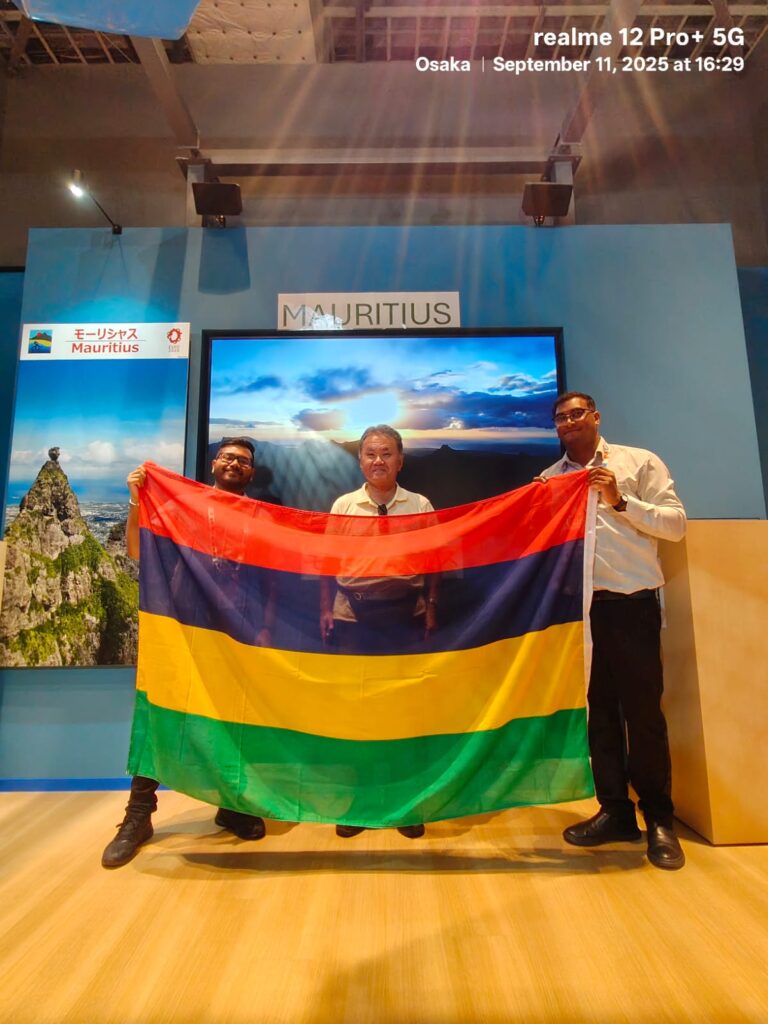
The Osaka Expo 2025, which concluded on 13th October, was a valuable opportunity for us. Many Mauritians had the chance to visit Japan, experiencing its culture firsthand, while thousands of Japanese visitors discovered Mauritius through the pavilion of Mauritius at the Expo. This event helped both countries discover new aspects of each other and opened doors for future exchanges.
At our embassy, we continue to promote Japanese culture, so please visit our website and Facebook pages to learn more!
8. Looking ahead to the post-TICAD9 period, what do you see as the biggest challenge or opportunity in achieving the shared goals of Japan and Mauritius?
TICAD9 was about co-creating the future, innovative solution and private sector-led growth. Japan and Mauritius share these common goals in the Africa region. Opportunities are many for Japanese businesses in Mauritius to expand into Africa in sectors already mentioned – financial services, ocean economy and renewable energy. With the Japanese cutting-edge technology and the Mauritius’s unique expertise as a gateway to Africa, we can make the region even more prosperous. I would like to ensure that for our part, we support the private sector by developing the foundations for business and promoting sustainable growth. Our doors are always open for suggestions and discussions.