

Published by Alvyn Ulrish Shad Savrimuthu
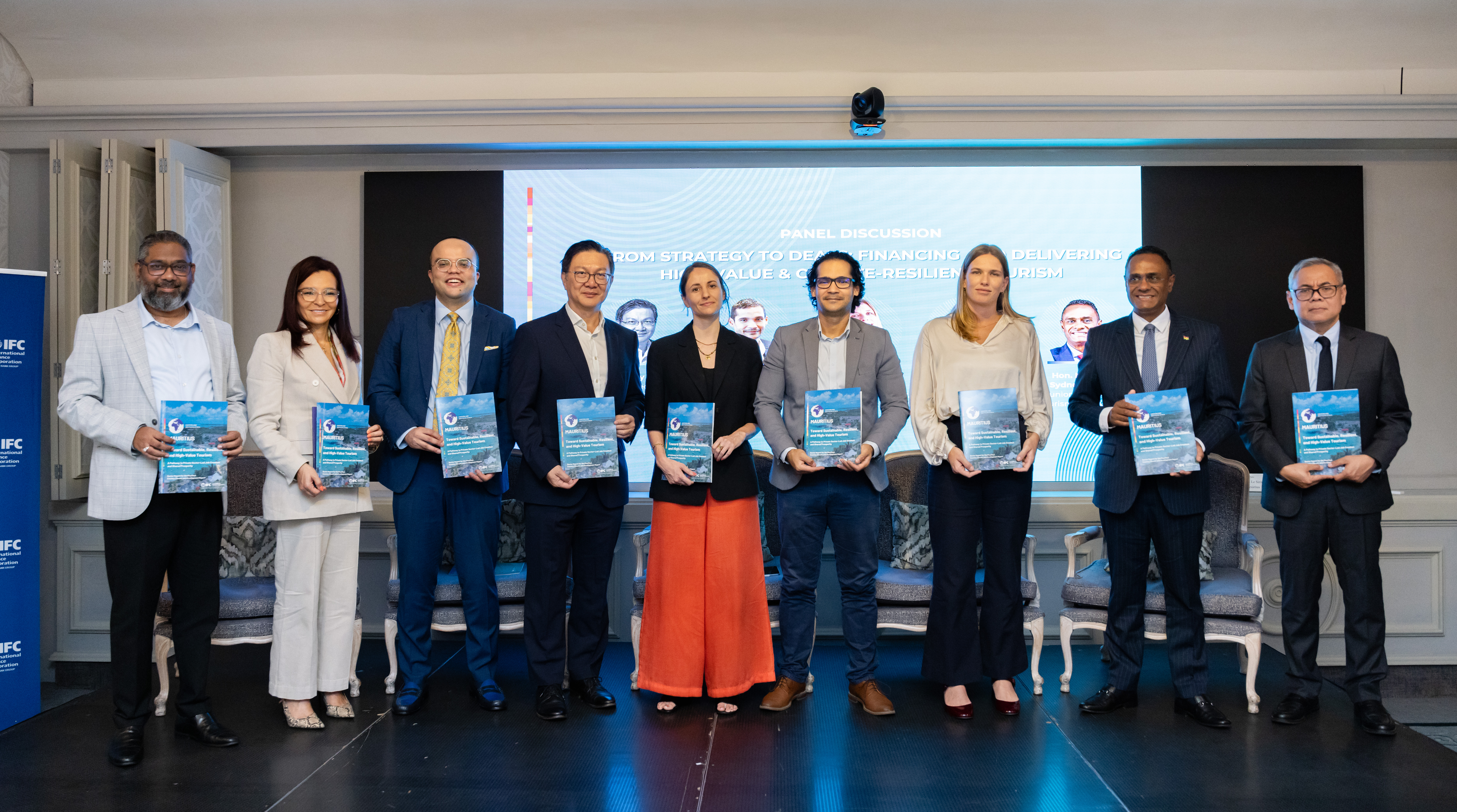
Following the high-level launch of the International Finance Corporation’s landmark report, Toward Sustainable, Resilient, and High-Value Tourism, held in Port Louis, the event transitioned into one of its most anticipated segments: a panel discussion titled “From Strategy to Deals: Financing and Delivering High-Value and Climate-Resilient Tourism.” Moderated by Rudy Veeramundar, Founder and Editor-in-Chief at Bizweek, the session brought together five practitioners from across the tourism and finance ecosystem to move the conversation from diagnosis to action. With Mauritius’ coastline, water resources, and competitive positioning all under increasing climate pressure, panellists were asked to confront the hard questions: how do you translate sustainability commitments into operational decisions, bankable investments, and measurable outcomes?
Hon. Mr Jean Sydney Pierre, Junior Minister of Tourism of Mauritius
The Junior Minister of Tourism set the tone with characteristic candour. Drawing on his background in the hospitality industry, he challenged the audience to move beyond arrival figures as the primary measure of success and to reckon honestly with the structural vulnerabilities the sector now faces. He used the analogy of the Titanic to underscore the urgency: the alarm, he argued, is already being raised, and the question is whether the industry will act before it is too late. “We need to understand that we are in a crisis mode, and this is a reality,” he said, drawing a parallel between the need for proactive planning and the simple act of leaving earlier when traffic demands it.
Jean Sydney Pierre was equally pointed on the question of product diversification, arguing that the case for it has nothing to do with beach erosion and everything to do with competitive positioning. Mauritius, he contended, has been selling itself the wrong way for years, featuring beaches in markets where the Maldives will always win on that ground. “We’ve been selling the wrong way,” he said plainly, pointing to an influencer who arrived in Mauritius expecting little and left astounded by what the inland and cultural offering had to reveal. The challenge, in his view, is one of narrative as much as infrastructure: Mauritius has the product. The industry must now show it.
Marine Dalais, Marketing and Sustainability Manager at CIEL Properties
Marine Dalais offered a perspective grounded in what a smaller, ecotourism-oriented operator has learned from building sustainability into its model from the outset rather than retrofitting it. At Ferney, where she works, conservation came first, with nature restoration placed at the centre of the business before commercial activities were developed around it. This sequencing, she argued, is what gives the model its coherence. “It all starts with not treating sustainability or regeneration as something separate from your core business identity, but really embedding it into your business model,” she said, describing how sustainability has become the DNA of day-to-day operations precisely because it is a shared responsibility across the organisation.
She outlined three pillars anchoring CIEL’s strategy: nature restoration and preservation, carried out through the Ferney Conservation Trust in partnership with government and NGOs, with more than 35,000 trees replanted to date; sustainable agriculture, built around a farm-to-table concept and a dedicated agri-hub that puts land and infrastructure at the disposal of local agri-entrepreneurs; and community integration, through which local producers and community members participate directly in the estate’s economic life. A particularly instructive example was Indika Pharma, a tenant agri-entrepreneur cultivating medicinal plants on site, transforming them into chemical-free wellness products that are then sold to tourists and supplied to hotel groups across the island. “We can really see how international funding can also help to fast-track things,” she noted, referencing support received through the Critical Ecosystem Partnership Fund as evidence that external capital can meaningfully accelerate on-the-ground impact when the model is credible and the partnerships are in place.
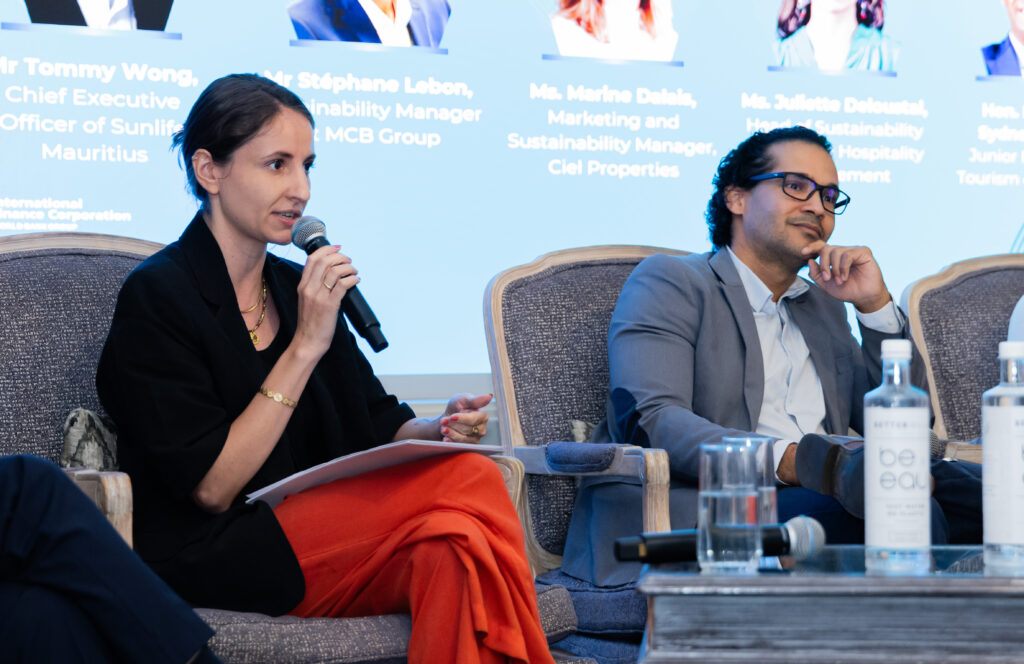
Juliette Deloustal, Head of Sustainability at Attitude Hospitality Management
Juliette Deloustal opened with a point of framing that she clearly felt was important to establish before anything else. Climate change, she argued, is not a crisis in the conventional sense of the term, because a crisis implies a temporary disruption after which things return to normal. What the sector is navigating is a permanent shift in operating conditions, and the language used to describe it matters. “We are not in a crisis,” she said. “It’s a long-term change and we are in that situation. It’s not going to change, and that’s the new normal.” The implication, she was careful to make clear, is that the industry cannot afford to manage this as a short-term problem requiring short-term fixes.
She then turned to the concrete ways in which climate and biodiversity risk are already affecting Attitude’s business, emphasising that the most significant dependencies on nature are often the least visible. Freshwater availability, natural coastal protection, the health of the lagoon ecosystem, and the natural cooling provided by intact reef and vegetation systems are services that have largely been free, but are becoming less reliable as conditions deteriorate. The financial reality is already tangible: one of Attitude’s hotels recently required significant capital expenditure for beach rehabilitation work, involving environmental impact assessments, monitoring programmes, and beach refining. “Before regeneration, we reduce the impact,” she said, outlining how the group is working to monitor energy and water use more rigorously, eliminate chemical products from operations, and raise guest awareness about the marine ecosystems they are enjoying. She also highlighted a concrete example of circular, locally anchored sourcing: Attitude’s spas now use exclusively local, 100 per cent natural organic products supplied by Indica, an arrangement that she described as mutually reinforcing for both operators and local producers.
Tommy Wong, Chief Executive Officer of Sunlife Mauritius
Tommy Wong approached the question of climate resilience from the perspective of asset protection, framing it squarely as a core business risk rather than an ESG consideration operating on the periphery of strategic planning. With the sector’s collective balance sheet carrying more than $20 billion in physical assets, the stakes are concrete. He noted that whilst cyclones have been relatively rare in recent years, the proliferation of high wave events has created a different kind of threat, one capable of erasing a beach overnight and with it the commercial viability of the property it anchors. “You don’t have a beach, you don’t have a business, and your balance sheet is wiped out,” he said. “It’s very simple like that.”
He then walked through the investment logic his group applies across different categories of climate risk. Energy efficiency, he acknowledged, is the more tractable end of the spectrum, offering reasonable payback periods and scalable implementation through a phased approach, from basic LED upgrades to high-specification equipment. Coastal protection, however, is a different proposition: capital-intensive, requiring significant technical expertise, and reliant on financing structures that the industry cannot engineer alone. “The help of government is much needed in terms of facilitation, in terms of financing, how do we package that together with stakeholders,” he said. Water security is a third dimension, and one he described as an emergency rather than a long-term concern: desalination has become a near-essential investment for operators facing severe shortages, even if it functions primarily on a standby basis. Across all three areas, his message was consistent: this is a long journey, still in active transition, but one that the industry must commit to systematically.
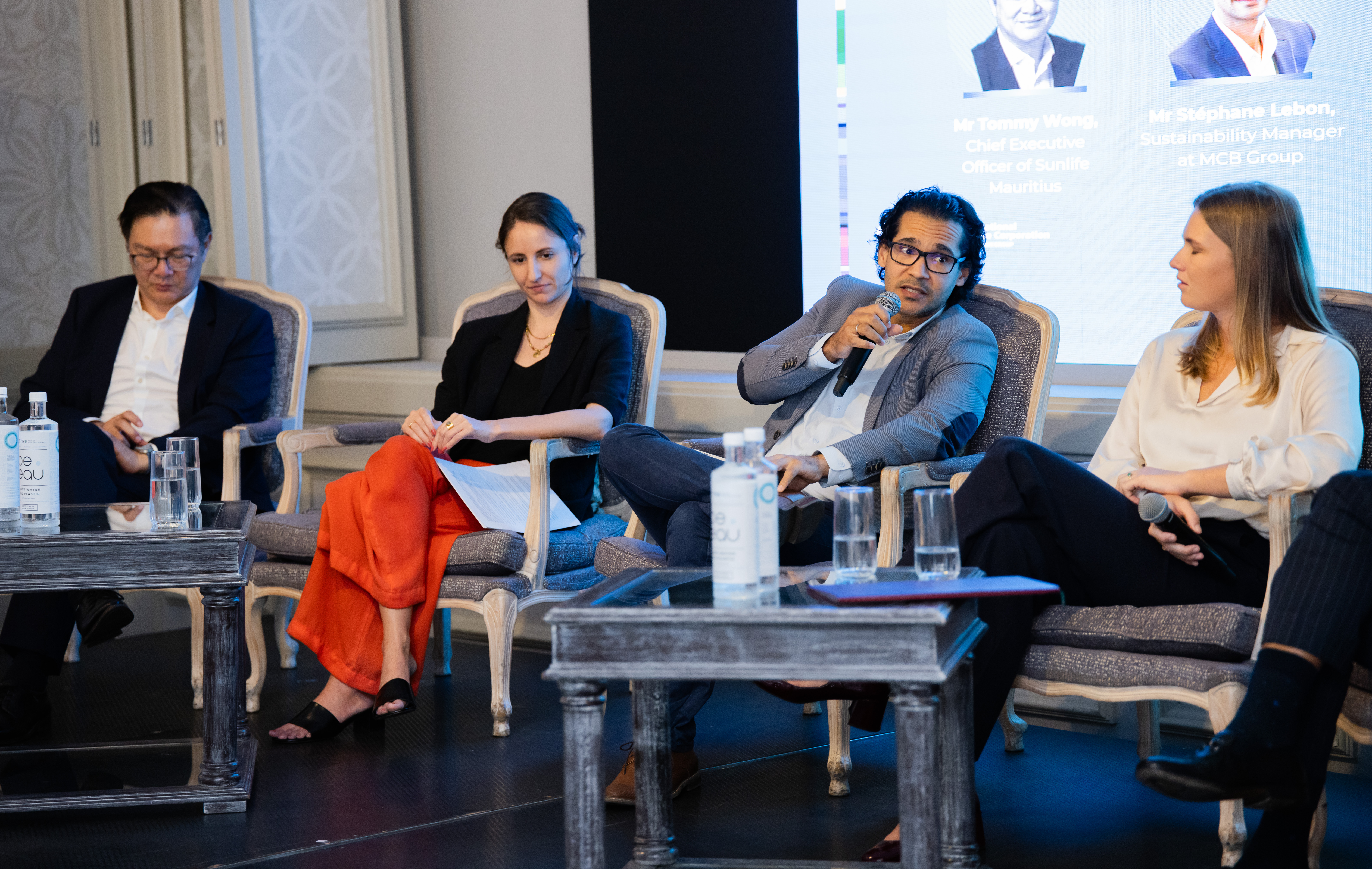
Stéphane Lebon, Sustainability Manager at MCB Group
Stéphane Lebon brought the perspective of a financial institution navigating the integration of climate risk into credit analysis, and he was candid about where that process currently stands. The Bank of Mauritius has issued guidelines on climate-related financial risk, and MCB, like many regional banks, has begun developing heat maps to assess sector-level physical and transition risk exposure. But the field, he argued, is still in its early stages, and one of the most significant constraints is the availability of granular, comparable ESG data from borrowers. “Today, when we talk about the tourism sector, what we ask are basic financial information, occupancy rate,” he noted. The next step, he suggested, will involve requesting emissions data, energy consumption per room, and scope metrics, but this shift requires a deeper communication channel between lenders and borrowers that has yet to be established in the mainstream.
He also identified a structural mismatch that sits at the heart of the financing challenge for climate adaptation: the gap between asset life and liability life. Projects such as coastal rehabilitation and mangrove restoration typically have payback periods of 15 to 25 years, whilst commercial banks in this region lend within a seven to ten-year time frame. This is precisely where blended finance enters the conversation, but Stéphane was honest about the gap between the concept and its practical application. “Blended finance is a great word, extraordinary,” he said. “But concretely, how does it work?” He argued that the sector must also develop formal frameworks for quantifying avoided losses, the financial benefit of preventing damage rather than generating new revenue, so that adaptation investments can be properly evaluated in credit assessments. Financing a beach rehabilitation programme, he noted, does not directly generate revenue, but it protects a balance sheet that would otherwise be severely impaired. Making that logic legible to credit committees, he suggested, is one of the most important challenges ahead, and one where institutions such as the IFC and the World Bank Group have a critical role to play in building standards and expertise.
A Panel That Matched the Moment
Across five voices and a wide range of institutional vantage points, the panel reached a set of consistent conclusions. Mauritius’ tourism sector faces climate-driven risks that are structural, not temporary, and that require responses embedded in business models, investment strategies, and financing frameworks rather than layered on top of them as optional enhancements. The case for product diversification, inland development, data-driven sustainability management, and nature-based solutions is no longer primarily ethical. It is commercial. What the panel made clear, and what Mr Veeramundar’s questions consistently drew out, is that the transformation is already underway in parts of the industry. The challenge now is to bring it to scale, at pace, and with the collaborative financing architecture that the moment demands.