

By Shruti Menon Seeboo
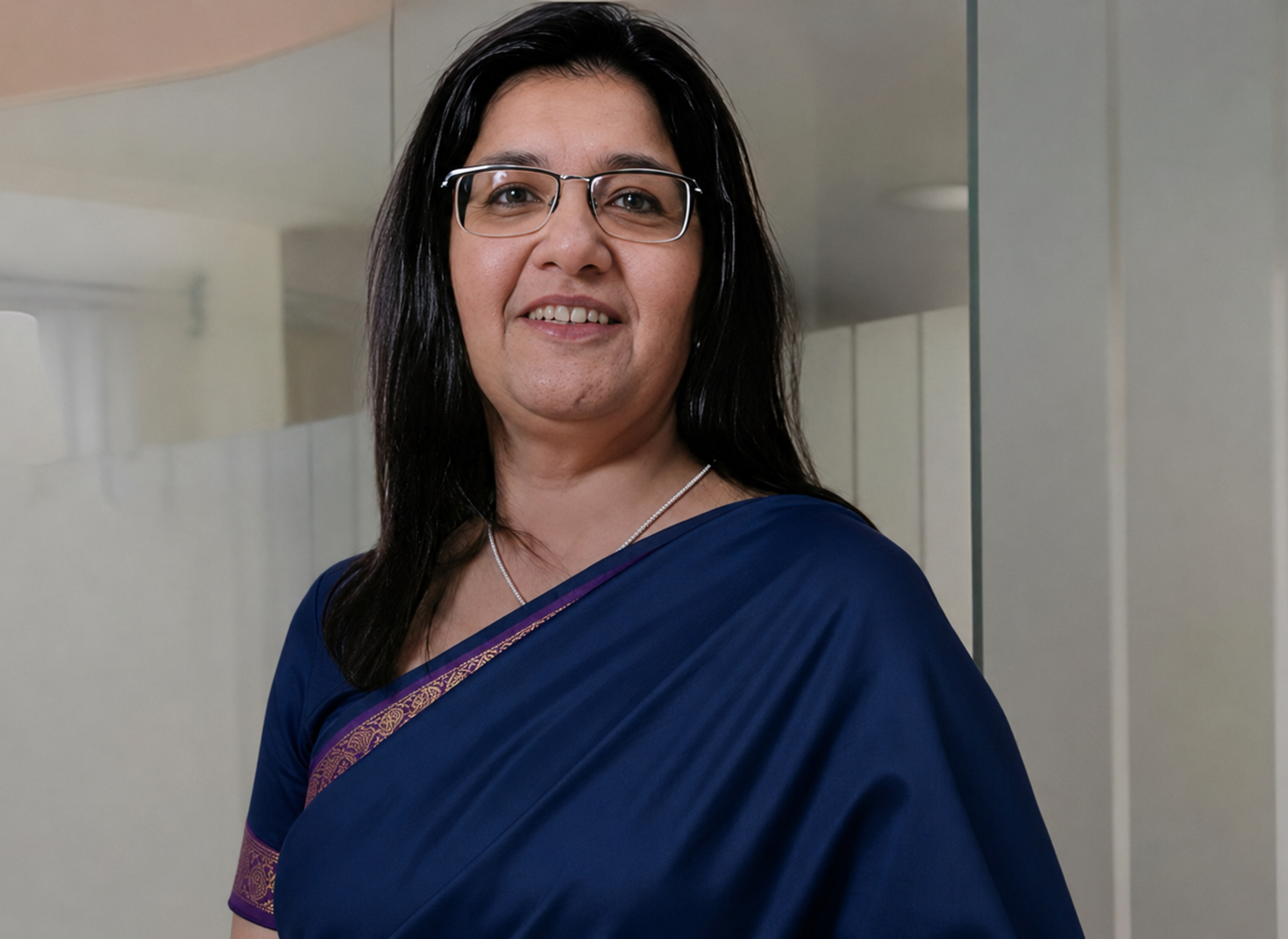
When the 6th India-Africa Entrepreneurship & Investment Summit convenes in Cape Town from 13 to 15 July, one of the most compelling voices in the room will belong to Padmaja Ruparel, Co-Founder of IAN Group — India’s single largest horizontal platform for seed and early-stage investments. Repeatedly recognised on Fortune India, Forbes India, and Business Today’s Most Powerful Women lists, and honoured by the Women Economic Forum with its Women of the Decade in Investment Banking award, Ruparel has spent nearly two decades building India’s early-stage ecosystem from a nascent concept into a globally referenced model.
She co-founded the Indian Angel Network, founded BioAngels — India’s first sector-focused angel investor group, established in partnership with BIRAC, the innovation arm of the Department of Biotechnology — and is Senior Managing Partner of both IAN Fund I, a US$55 million SEBI-registered venture capital fund, and the newly launched IAN Alpha Fund, a US$125 million SEBI-registered AIF Category II venture capital fund. A member of the Government of India’s National Economic Advisory Council, Board Member of SIDBI and the Technology Development Board, and Co-Chair of the Global Business Angel Network, she arrives in Cape Town with a clear and practical vision for what the Africa-India investment corridor can become — and precisely how to get there.
On the playbooks from India’s angel network evolution that can be most directly mapped onto the Africa-India corridor, Ruparel points to the power of cross-border angel networks as the most immediately actionable lever. “Africa has introduced angel investing through various angel networks and ABAN, which is excellent,” she says. “Going forward, there clearly is a need to derive value from different geographies, business models as well as talent to not only create large companies for Africa but to build global companies.” The mechanism she advocates is specific. “By bringing in early-stage investors from India — or other countries — will help companies get warm introductions, new business leads, access to talent and so on,” she says. “Hence, an angel investor group which can invest cross-border would bring in value.”
She draws directly on IAN‘s own experience to make the case. “For IAN, by bringing in angels from other parts of the world has really helped companies to expand in other geographies and create unicorns,” she says. “This playbook can be expanded for African and Indian investors to engage as well in cross-border investments.” The underlying logic, she explains, goes beyond capital alone. “This is critical to attract investors from other countries as their investment would not only be based on the founder or company but also based on the credibility of the local investor who is also mentoring and guiding the company,” she says. “This unlocks the power of ‘promoter and peer investing’ for investors.” IAN’s international expansion offers a tested template. “This is exactly how IAN, by launching in London and onboarding UK-based investors, could invest in the UK,” she says. “And used the same playbook to invest in Sri Lanka, the US, and elsewhere.”
On the appetite for deep tech, agritech, and biotech across the India-Africa corridor, Ruparel sees a wealth of synergies that remain substantially untapped. “I think there is a lot of synergy in India and Africa in deep tech, agri, bio and other sectors,” she says. She identifies South Africa’s space tech industry as a particularly compelling example. “South Africa’s space tech industry is very interesting and there’s huge traction,” she says. “Indian space tech companies could absolutely collaborate and together they could build complementary partnerships to cater to customers globally.”
In agriculture, she sees multiple tracks available for development. “Between India and Africa, various tracks can be built like seed diplomacy, training programmes for modern sustainable farming, digital platforms for agricultural information dissemination and financial tools — like Unified Payments Interface — to empower smallholder farmers for transparent agricultural trade,” she says. Healthcare presents an equally compelling opportunity. “Healthcare is another sector where both India and Africa could add tremendous value — India is already known as the pharmacist of the world and this was very evident during Covid,” she says. “Local manufacturing hubs for cost-effective but global-quality medical devices could be set up, along with cross-border remote medical consultation and robotic surgery, and the establishment of joint research networks, amongst many others.”
The overarching thesis, she argues, is one of shared value creation. “The power of talent from both India and Africa is what can create value leveraging technology, IP, and knowhow,” she says. “It will enable us to create solutions for our economies at a cost which India and Africa can afford. Once this model is created and demonstrated, it will not only help build for Africa and India but essentially the entire world.”
On the formula for convincing traditional wealth holders to back high-risk, early-stage founders, Ruparel is characteristically precise. She identifies several pillars on which IAN’s traction was built. “The model where each investor would invest a very, very small amount in each company — an amount which investors can easily afford to lose, and yet for the entrepreneur to raise the amount required — ensured a low entry barrier for investors,” she says. Equally important was the design of the platform itself. “We built a platform for risk-mitigated investing,” she says. “This brought in investment opportunities from diverse sectors, geographies — both India and overseas — and business models. Hence, investors could build their own investment portfolio thesis.”
Beyond capital, she argues, the value-add dimension has been critical. “IAN‘s investment strategy, fundamentally, is to invest in ‘best of the next’, which really meant that innovation was central,” she says. “This ensures IAN brought in more than just investment opportunity — it exposes investors to learn from disruptive and innovative founders.” The cumulative effect, she says, has been a genuinely diverse and active investor community. “All of this has enabled IAN to widen its investor group and engage a very diverse and active group of investors,” she says.
On the vision of a truly unified Global South angel network — where an Indian angel and a South African angel might seamlessly co-invest in a Nigerian startup — Ruparel is both enthusiastic and clear-eyed about what stands in the way. “Yes, I would surely explore an angel investment group which includes investors from Africa and India,” she says. “And the objective would be to invest in companies in Africa and India which could leverage both markets.”
The primary obstacle, she identifies, is regulatory. “The only barrier we would need to sort out is regulatory issues,” she says. But she is equally clear about where the solution lies. “Platforms like the India Africa Entrepreneurship and Investment Forum that has been built could hugely help not only enable the discussions to enable cross-border investing, but also accelerate investment and growth of investee companies,” she says — a conviction that brings her to Cape Town this July with both a playbook and a purpose.